We already have logs. Why isn't that enough?
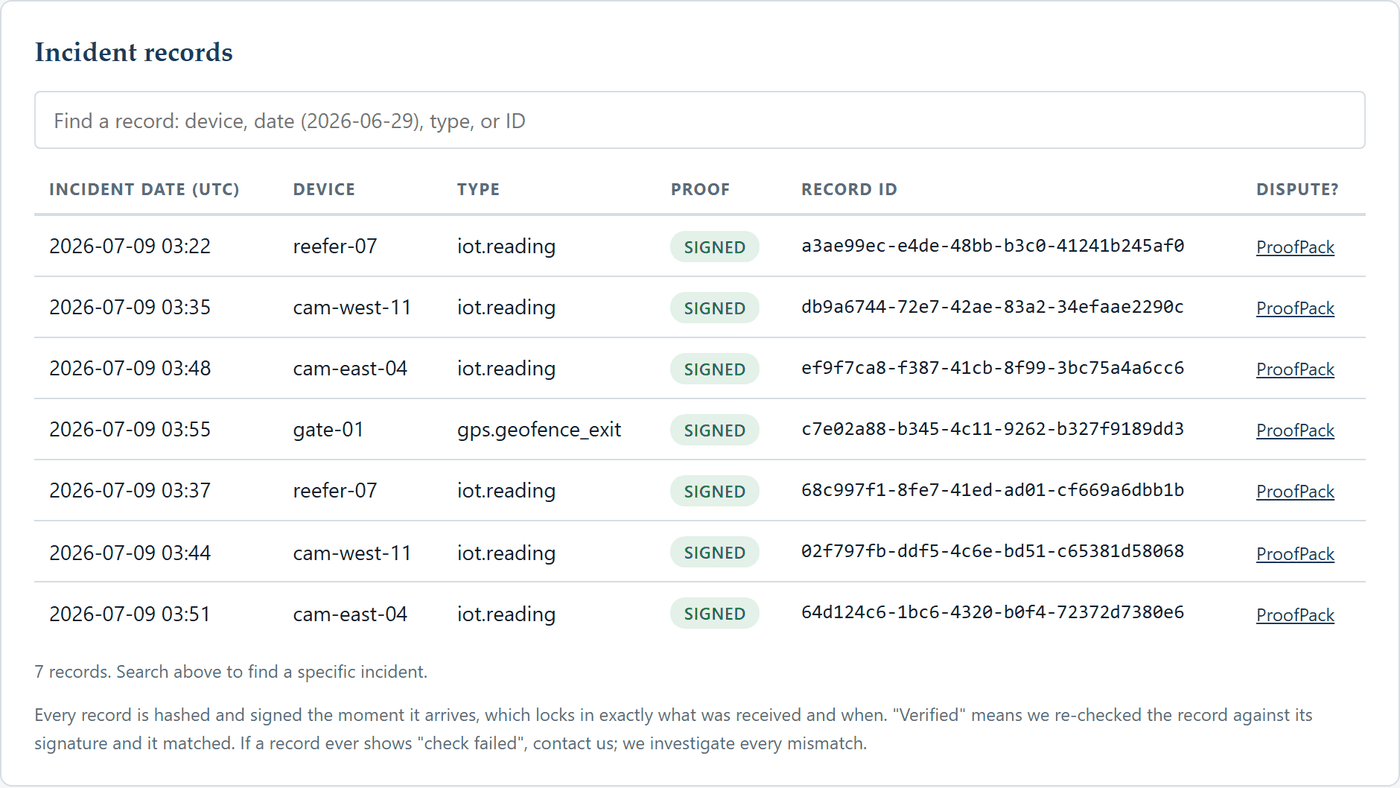
Because anyone with admin access can edit them, and that's why adjusters and opposing counsel discount them. Lumra records are sealed the instant they arrive and chained; altering one breaks verification, as you saw above.
Will this work with the systems we already have?
If your platform can send a webhook or an HTTPS request, yes: telematics platforms such as Samsara, Motive, and Geotab support webhooks, as do most VMS and IoT hubs, and anything custom can call the events API directly. Consumer devices with no webhook output need a small bridge; ask us and we will point you at the shortest path. No hardware is replaced and no media is uploaded.
Why can't our IT team just hash and sign our own logs?
They can, and it will read as self-audited paperwork the day it matters: when your company controls the database, the keys, and the script, there is no good answer to "could the hashing have been re-run after an edit?" Lumra provides the separation of duties: records sealed the instant they arrive, signed at the source where the device supports it, chained outside your administrative reach, and verifiable by the other side with open tools that never contact PriviNet.
Why isn't a WORM bucket (S3 Object Lock) enough?
Object Lock protects retained objects from later change. Lumra adds signed records, explicit receipt ordering, package manifests, and a verifier another party can run without access to your cloud account. When an RFC 3161 token is present, the verifier checks what digest it covers and reports its timing scope. These controls complement locked storage; neither one proves that the source event was true or that every expected event was captured.
Do you see our video or audio?
No. Lumra works from compact signed metadata. Raw media stays yours; it can only be recalled under an audited, logged process. We can't leak footage we never receive.
What if PriviNet disappears?
Your records outlive us. The verifier is a standalone open tool that never phones home; anyone can re-check any record for as long as they keep it, with no PriviNet server involved. Proof that requires trusting the vendor isn't proof.
Is this blockchain?
No tokens, no mining, no consensus fees. Just the boring, court-tested cryptography (ECDSA and Ed25519 signatures, SHA-256 hash chains) that federal evidence rules already recognize.
How do dashcam videos hold up as evidence?
Dashcam footage holds up when you can prove nobody edited it after the fact. Your video platform hashes each segment; Lumra seals those hashes the moment they arrive into a tamper-evident chain. Under Federal Rules of Evidence 902(13) and 902(14), hash-verified records like these can self-authenticate through a qualified person's written certification rather than live testimony. Weeks later, anyone can hash the file they received and match it against the hashes committed on the day of the incident.
What is a tamper-evident audit log?
A tamper-evident audit log is a record of alerts, notifications, and responses that cannot be edited after the fact without detection. Lumra signs each event the instant it arrives, such as a geofence exit or a staff acknowledgment, and chains it to the previous record. If an entry is altered or inserted later, verification fails. Opposing experts can check the timeline themselves with a free standalone verifier.
How do you prove chain of custody for cargo?
Chain of custody is proven by signed records at each handoff. Lumra seals gate-in, yard moves, seal checks, and gate-out events the moment they arrive, verifies the device's own signature where source keys are enrolled, then chains the records so any rewrite is detectable. When a container arrives damaged, an adjuster who trusts no party can verify each record independently and narrow the loss to a specific custody window instead of relying on competing paperwork.
What is a cryptographically verifiable event record?
A cryptographically verifiable event record is an event that is digitally signed where it happens when the device supports signing, or sealed on arrival when it does not, and linked by hash to the record before it. The signature proves which enrolled device or person created it, or that Lumra sealed it on arrival, and the hash chain proves nothing was altered, inserted, or deleted afterward. Verification requires only the exported records and open cryptographic checks, not access to the vendor's systems.
How is this different from evidence vaults, photo apps, or free timestamping?
Different job. Evidence-management platforms are vaults: you upload media and trust whoever runs the vault. Photo-verification apps authenticate media captured through their own camera flow, and nothing outside it. Free timestamping proves a hash existed by a certain time, with no event, no custody, no paperwork. Lumra signs the operational events themselves, from the systems you already run, never takes your media, and hands you records anyone can verify plus the certification template to use them. And unlike most of the category, the pricing is on this page.
What stops PriviNet itself from rewriting history?
The exported package is checked outside PriviNet: the standalone verifier recomputes signed content, checks the package structure and trust root, and fails if protected content was changed. Production signing uses a non-extractable cloud HSM key. External timestamp evidence is reported separately and only proves the digest existed by the token time; missing or unconfirmed trust is shown instead of rounded up.
What is a ProofPack, and is verification free?
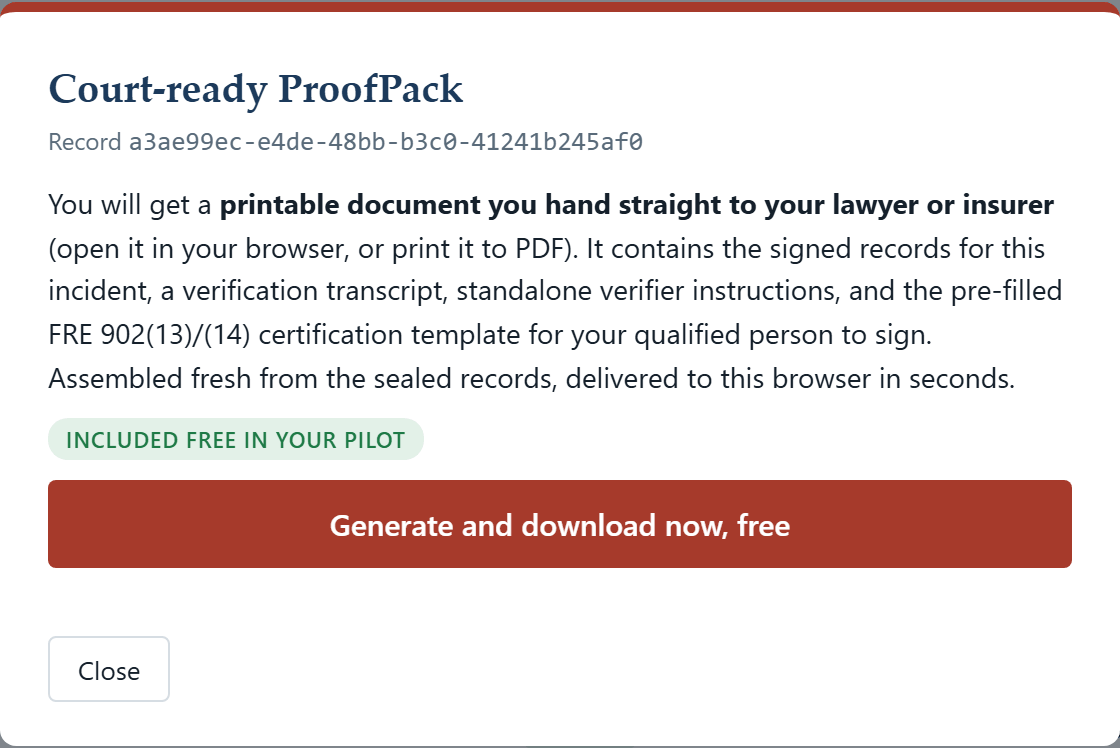
Verifying a supported ProofPack is free and needs no PriviNet server. A ProofPack is a portable evidence package containing signed records, package metadata, verification instructions, and, where applicable, timestamp and certification material. It can support a legal or insurance evidence workflow, but it is not itself a legal conclusion or guarantee of admissibility.
What is the Evidence Trust Assessment in a ProofPack?
A fixed, versioned checklist that runs on every record and reports only what it found: whether the source signature was present and verified, whether the timing lines up, the chain of custody, and, across a multi-source incident, whether independent vendors' records agree. It is enumerated facts, not a score and not an opinion about what happened. When nothing is flagged it says so by name, listing the checks that ran. It rides inside the sealed pack, so altering it breaks verification like any other sealed value. It is there to help a reader weigh the evidence, never to decide fact or liability.